
Rainbow Yoga articles
The Child Who Does Every Pose But Still Feels Outside the Circle
Why belonging matters in kids yoga, and how teachers can build connection through partner play, human mandalas and small acts that make room for every child.
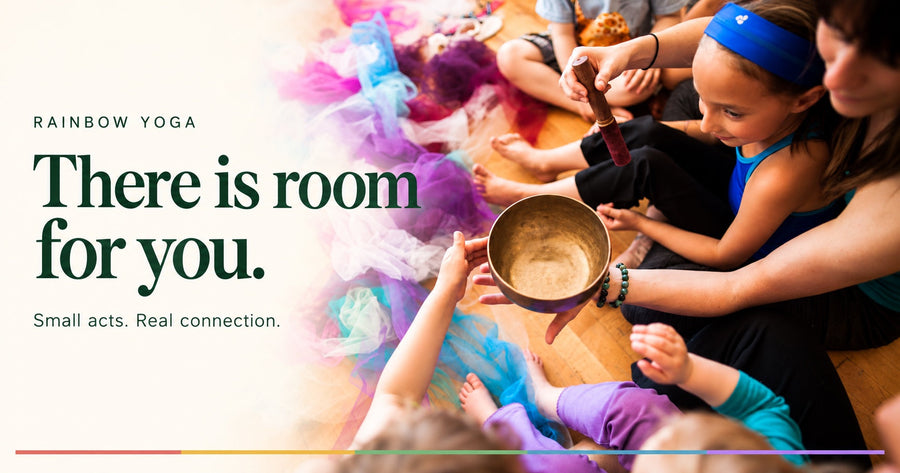
Why belonging may be one of the most important things we teach children, and why anti-bullying needs to become much bigger than telling children to “be kind”
There is a child in the yoga class who does everything right.
Tree Pose? Excellent.
Downward Dog? Woof.
Partner Boat? Legs up.
Sun Salutation? They could probably teach it.
They listen. They cooperate. They remember which foot goes where. They know not to kick anybody in the nose during Happy Baby, which already puts them ahead of a surprising percentage of the population.
And yet…
When I say, “Find a partner,” something happens.
It is tiny.
Almost invisible.
Twenty children become ten pairs.
And one child becomes mathematics.
Everyone looks somewhere else.
Someone suddenly finds the floor fascinating. Someone grabs their best friend with the urgency of a passenger securing the last lifeboat on the Titanic.
The child smiles.
“I don’t mind.”
Sometimes those are three of the saddest words in childhood.
Because the child may genuinely not mind this once.
But perhaps yesterday there was nobody beside them at lunch.
Perhaps last week they discovered there was a birthday party everybody knew about except them.
Perhaps the group chat has become a small electronic country from which their visa has quietly been revoked.
Perhaps nobody is actually bullying them in the way adults recognise bullying.
No punching.
No spectacular playground villain demanding lunch money while stroking a white cat.
Just the thousand tiny messages that say:
You are here. But you are not really one of us.
And that is what I want to talk about in the wake of Australia’s Bullying No Way Week this year. Because this conversation needs to continue long after the week ends.
Not only bullying.
Belonging.
Because a child can be perfectly safe from being shoved into a locker and still spend their entire day standing emotionally outside the circle.
Bullying Is Bigger Than the Bully
Australia’s 2026 Bullying No Way Week ran from 17 to 21 August, with the theme “Small Acts, Big Impact.” (bullyingnoway.gov.au)
I love that theme.
Because childhood culture is largely built from small acts.
A chair moved over.
A name remembered.
An eye roll.
A whisper.
A space made at the lunch table.
A message deliberately unanswered.
A child chosen first.
A child chosen last.
A child not chosen at all.
Adults sometimes look for bullying as though we are airport security searching for contraband.
Did somebody hit you?
No.
Threaten you?
No.
Call you a horrible name?
Not exactly.
Excellent! Childhood successfully completed!
Except belonging doesn’t work that way.
Bullying commonly involves repeated aggression and an imbalance of power, and it can be physical, verbal, social or online. (StopBullying.gov)
But there is also relational aggression: excluding, humiliating, spreading rumours, manipulating friendships and making somebody understand that access to the tribe can be withdrawn at any moment.
And humans are extraordinarily tribal animals.
We invented opera, quantum physics and cinnamon scrolls, but apparently we are still deeply concerned about whether the other primates are going to let us sit beside them.
For children and teenagers, that concern can become enormous.
UNESCO reports that about one in three learners globally experiences bullying at school each month. More than a third experience physical fighting, almost one in three report being physically attacked at least once in a year, and cyberbullying affects as many as one in ten children. (UNESCO)
In Australian longitudinal data collected in 2016, seven in ten children aged 12–13 reported experiencing at least one bullying-like behaviour during the previous year. (AIHW)
Different studies define and measure bullying differently, so we should resist turning childhood suffering into a statistical Olympics.
But whichever dataset you pick, the conclusion is difficult to wiggle out of:
A great many children know what it feels like to be targeted, rejected, humiliated or excluded by their peers.
And some children are living with it every single day.
When “Just Ignore Them” Is Not Enough
Adults give some magnificent advice to bullied children.
“Just ignore them.”
“Walk away.”
“Don’t let it bother you.”
“Be the bigger person.”
Excellent.
Next week perhaps we can tell people with hay fever simply to ignore pollen.
A child cannot always decide that social rejection no longer matters.
Their nervous system is participating in the conversation too.
Belonging is not a decorative emotional extra that we sprinkle over childhood after literacy and numeracy have been completed.
It is deeply connected with wellbeing.
Australia’s Institute of Health and Welfare specifically identifies social isolation, loneliness, bullying and strained relationships among the experiences that can increase psychological distress and risk of mental-health problems in young people. (AIHW)
Long-term research has also linked childhood bullying victimisation with later mental-health difficulties. (JAMA Network)
And then we reach the part of this article where the jokes need to become quieter.
Because sometimes exclusion is not merely unpleasant.
Sometimes children are hurting far more deeply than the adults around them realise.
We Need To Talk About Suicide Carefully, But We Need To Talk About It
Bullying does not have a simple one-to-one relationship with suicide.
A suicide is extraordinarily complex. It cannot responsibly be attributed to one argument, one bully, one website, one school or one event.
But bullying is an important risk factor, and pretending otherwise does children no favours.
A major meta-analysis of research involving children and adolescents found that peer victimisation was associated with more than twice the odds of suicidal ideation and approximately two-and-a-half times the odds of suicide attempts. (JAMA Network)
Research involving adolescents aged 12–15 across 48 countries has likewise found an association between bullying victimisation and suicide attempts. (Koyanagi and colleagues, 2019)
Globally, the World Health Organization estimates that 727,000 people died by suicide in 2021, and suicide was the third leading cause of death among people aged 15–29. (World Health Organization)
Here in Australia, the numbers deserve our attention too.
In 2024, suicide remained a leading cause of death among young Australians. More than one quarter of deaths among people aged 15–24 were due to suicide, and the suicide rate for that age group was 9.2 per 100,000, higher for young males than young females. (AIHW; AIHW: Health of young people)
These are not numbers to use for shock value.
Behind every number is somebody’s child.
Somebody who had favourite music.
Somebody who rolled their eyes when their mother asked them to put their clothes away.
Somebody who might have hated broccoli, loved horses, wanted purple hair, stayed awake reading fantasy novels, worried too much, laughed too loudly or did an absolutely terrible Tree Pose.
Somebody whose place in the world cannot be represented by a decimal point.
So yes, we need effective bullying policies.
Yes, schools need reporting procedures.
Yes, adults need to intervene when children are being harmed.
But I think we also need to ask a bigger question:
What are we doing, every day, to make children experience themselves as wanted?
Because preventing cruelty is only half the job.
The other half is creating connection.
A Child Can Be Included Without Belonging
This distinction matters.
Inclusion is often logistical.
You may enter the classroom.
You may join the activity.
You may sit in the circle.
Belonging is emotional.
We noticed when you arrived.
Something would be missing if you weren’t here.
Your ideas matter.
Your weirdness is welcome.
There is room for you.
I have become increasingly interested in that difference through teaching children.
You can arrange twenty children into a beautiful yoga circle and congratulate yourself on your excellent inclusivity.
Look!
A circle!
Nobody has been expelled!
Photograph it immediately!
But then watch more closely.
Who is always beside the teacher?
Who is making everyone laugh?
Who gets interrupted?
Who gets copied?
Who gets avoided?
Who chooses quickly when you say “Find a partner”?
Who pretends not to care when nobody chooses them?
Who becomes silly precisely at the moment connection is required?
Who dominates every activity because being powerful feels safer than risking being rejected?
Who is physically in your circle…
but socially orbiting somewhere near Saturn?
That is where teaching gets interesting.
Sometimes the “Difficult Child” Is Auditioning for Belonging
We should also be careful about dividing children into neat categories of bullies and victims.
Children are inconveniently complicated.
Research has long identified children who are both perpetrators and targets of bullying, and some evidence suggests this group can experience particularly serious difficulties. (JAMA Network)
Sometimes the child who keeps making everyone laugh is trying to secure their place.
Sometimes the child who humiliates another child is terrified of becoming the next target.
Sometimes the controlling child has discovered that if you cannot guarantee love, power makes a surprisingly effective substitute.
Sometimes the child disrupting every group activity is asking:
“Will you still keep me if I’m difficult?”
That doesn’t mean harmful behaviour should be tolerated.
Kindness without boundaries becomes chaos wearing a flower crown.
Children need clear limits.
They need adults to stop cruelty.
They need consequences, repair and accountability.
But children also need adults who are curious enough to look underneath behaviour.
Because:
“How do I stop this behaviour?”
and
“What is this child trying to get from the group?”
are very different questions.
Sometimes the answer to the second is astonishingly simple.
A place.
This Is Where Yoga Can Either Help Or Completely Miss the Point
I love yoga.
Obviously.
I have spent decades teaching it.
But yoga itself is not magical fairy dust.
A yoga class can reproduce exactly the same hierarchy as a playground.
Who is flexible?
Who can balance longest?
Whose handstand gets applause?
Who looks beautiful doing the pose?
Who needs help?
Who is always picked as the demonstration child?
If yoga becomes another arena in which children discover who is best and who is inadequate, we have merely moved the playground politics onto prettier mats.
That is why, in Rainbow Yoga, I keep coming back to partner yoga, group poses, games, shared challenges, human mandalas and activities where children actually have to notice one another.
The pose is not the destination.
Sometimes it is barely the beginning.
A partner pose asks:
Can I listen?
Can I adjust?
Can I trust?
Can I help without controlling?
Can I notice when somebody is uncomfortable?
Can I make room?
Can we fail together without blaming anyone?
Can we laugh when our magnificent four-person architectural achievement collapses after approximately 1.7 seconds?
Now we are practising something interesting.

The Human Mandala
One of my favourite Rainbow Yoga ideas is the Human Mandala.
Children form a circle together, often connecting through movement or shared shapes.
It photographs beautifully.
But that is the least interesting thing about it.
The interesting thing is that a mandala doesn’t work if somebody is treated as irrelevant.
Remove one piece and the pattern changes.
That is belonging made physical.
Not:
“You are allowed to participate.”
But:
“We actually need you.”
There is a phrase I have used in our classes:
I am different and I belong.
Not:
I belong if I become like everybody else.
Not:
I belong once I learn the secret handshake, acquire the correct shoes, stop being autistic, become less shy, become less loud, lose weight, learn English, become sporty, stop stimming, straighten my hair, hide my family, conceal my anxiety or discover whatever mysterious social operating system everyone else appears to have downloaded.
I am different.
And I belong.
Both things can be true.
That tiny word and may be doing some of the most important work in education.
“Find a Partner” Is Not an Innocent Instruction
This is something I would love every children’s yoga teacher, classroom teacher and sports coach to notice.
When you say:
“Everyone find a partner!”
you have just launched a tiny social experiment.
Watch.
Do not immediately rearrange the yoga mats.
Watch the children.
You will learn more about the social geography of the group in eight seconds than you may learn from a forty-minute discussion on friendship.
Who searches confidently?
Who has already been claimed?
Who waits?
Who turns away?
Who gets fought over?
Who quietly approaches the child nobody else approached?
That last child is practising something magnificent.
And this is where the 2026 Bullying No Way theme, Small Acts, Big Impact, becomes profoundly practical. (Department for Education)
Belonging is built through microscopic acts.
“Come with us.”
“Sit here.”
“You can be my partner.”
“Do you want a turn?”
“Let’s ask Maya.”
“There’s room.”
“I noticed you weren’t here yesterday.”
“Are you okay?”
Small sentences.
Huge architecture.
The Research Says Connectedness Matters
There is good reason to take this seriously.
In the United States’ national Youth Risk Behavior Survey, strong school connectedness was associated with lower prevalence across all measured mental-health and suicide-risk indicators. (CDC)
Earlier analysis of national U.S. data likewise found that students who felt connected to people at school tended to report fewer harmful behaviours and adverse experiences. (CDC)
This does not mean belonging is some kind of psychological forcefield.
Connected children can still become depressed.
Loved teenagers can still experience suicidal thoughts.
A wonderful yoga teacher cannot fix every problem with Partner Warrior II.
If only.
We would have solved civilisation by Tuesday.
But connectedness appears to be one of the protective threads running through young people’s wellbeing.
And that gives teachers something extraordinarily hopeful.
Because we cannot control every corner of a child’s life.
We cannot control every group chat.
We cannot control what happens in every home.
We cannot eliminate adolescent insecurity, jealousy or social stupidity. Frankly, many adults are still working on those.
But we can influence the culture of the room we are standing in.

Don’t Just Tell Children To Be Kind. Engineer Opportunities To Practise It.
Schools love kindness posters.
CHOOSE KINDNESS!
Excellent.
Beside it perhaps:
CHOOSE CALCULUS!
Knowing that kindness exists is not the same as possessing the social courage to practise it.
Children need rehearsals.
Let them practise noticing.
Let them practise inviting.
Let them practise disagreeing without banishing.
Let them practise being partnered with someone other than their best friend.
Let them practise asking consent.
Let them practise hearing “no” without making somebody pay socially for saying it.
Let them practise repairing a friendship.
Let them practise saying:
“I didn’t like that.”
“I went too far.”
“I’m sorry.”
“Do you want to join us?”
“I think we left him out.”
“Can we start again?”
That is social education.
And play, yoga and movement give us a laboratory for it.
Make the Circle Porous
There is another mistake adults make when trying to create belonging.
We imagine everybody must participate in exactly the same way.
They don’t.
Some children love the centre.
Some children need the edge.
Some need ten minutes watching before joining.
Some don’t want to be touched.
Some want to roar.
Some want to whisper.
Some communicate brilliantly through movement and terribly through conversation.
Some need to leave the pose.
Some need to leave the circle.
Belonging does not mean:
You must conform in order to participate.
A truly inclusive circle has doors.
You can come closer.
Move away.
Observe.
Return.
Choose.
Because forcing participation can turn our beautiful activity about connection into another experience of having your boundaries ignored.
The goal is not to produce twenty identically cooperative children.
Please no.
That sounds less like education and more like the opening scene of an unsettling science-fiction film.
The goal is to create enough ways of participating that children can discover:
There is a version of belonging available to me here.
Teach the Bystanders
There is also a child we don’t talk about enough.
Not the bully.
Not the bullied child.
The child standing two metres away pretending to inspect their shoelaces.
Bystanders matter enormously because bullying is partly a social performance.
Power needs an audience.
Exclusion needs cooperation.
Sometimes nobody has explicitly decided to reject a child.
Everybody has simply noticed everybody else rejecting them and quietly followed the choreography.
This is where adults can help children practise a different choreography.
Not superheroics.
We don’t need to tell a frightened eight-year-old to march into the playground and deliver a TED Talk on social justice to the largest bully in Year Six.
Small acts.
Stand beside someone.
Get an adult.
Invite the excluded child into your game.
Don’t forward the screenshot.
Don’t laugh.
Send the message.
Sit in the empty chair.
Say, “That’s not funny.”
Children need to discover that courage does not always roar.
Sometimes courage just shifts one chair sideways.

And Notice the Child at the Edge Before They Have To Scream
In my teaching, I keep returning to one simple practice:
Notice the edge.
Who is there?
We naturally notice the loud children.
They are extremely committed to being noticed.
But what about the quiet child who has gradually disappeared?
The teenager whose attendance has become irregular?
The child whose friends suddenly changed?
The child who says “whatever” to everything?
The child who used to participate and now doesn’t?
The child who is always “fine”?
We should never diagnose a child from one behaviour.
But we can notice.
We can ask.
We can make space.
Sometimes “I see you” is not metaphorical.
It is an intervention.
In one of our Rainbow Yoga class themes inspired by Avatar, we explored exactly those words:
I see you.
Not:
I see your behaviour.
I see your grade.
I see whether your pose is correct.
I see whether you are convenient.
I see you.
For a child who has spent the day socially disappearing, that can matter enormously.
Maybe Anti-Bullying Week Needs a New Question
Of course we should ask:
How do we stop children hurting each other?
But perhaps underneath it sits another question.
How do we build communities where children become harder to disappear from?
Imagine if every teacher became interested in that.
Every coach.
Every yoga teacher.
Every parent hosting the birthday party.
Every child.
Not through compulsory friendship.
Children should not be forced to be best friends with everyone. Neither should adults, unless we are finally prepared to demonstrate this principle ourselves at Christmas lunch.
Belonging does not require universal friendship.
It requires dignity.
Safety.
Recognition.
Participation.
Choice.
And enough human connection that a child does not conclude:
Nobody would notice if I vanished.
That sentence should haunt us far more than whether everybody can perform Tree Pose.
The Most Important Pose May Be Making Room
At the beginning of this article, there was a child nobody chose.
Let’s return there.
Twenty-one children.
Ten pairs.
One leftover.
Perhaps the teacher says:
“Come and be my partner.”
That is kind.
But tomorrow something better happens.
Another child looks across the room.
They notice.
There is half a second where they could look away.
They don’t.
They wave.
“Come with us. We’ll make three.”
And suddenly the mathematics changes.
Not twenty children plus one.
Twenty-one.
Together.
Nothing spectacular happened.
No assembly.
No anti-bullying wristband.
No celebrity video.
No PowerPoint presentation entitled RESILIENCE featuring a stock photograph of children jumping simultaneously on a beach.
Just a child making room.
Small act.
Big impact.
And maybe this is one of the things yoga can offer children that goes far beyond flexibility, strength or calm.
We can make circles.
And then we can teach children to notice who is missing from them.
We can make partner poses.
And teach them that another body is not equipment.
It is another person.
We can make human mandalas.
And let children experience physically that when one person moves, the entire pattern changes.
We can practise balance.
Not only standing on one foot.
The far more difficult balance between being ourselves and being part of something larger.
We can teach children:
You do not have to earn your humanity by fitting perfectly into the pose.
You don’t have to become less strange, less sensitive, less enthusiastic, less quiet or less you.
There is room.
Scoot over.
Make the circle bigger.
Because perhaps the most important thing a child takes home from yoga will never be a yoga pose at all.
Perhaps it will be the memory of a room where somebody looked up…
saw them standing at the edge…
and said:
“Come here. We need you too.”
A note for the adults
Bullying should always be taken seriously, especially when a young person is becoming withdrawn, distressed, frightened of school, talking about hopelessness or indicating that they may harm themselves. Bullying is one risk factor among many, and suicide is complex; no single event should be assumed to explain it. Current evidence supports both effective anti-bullying interventions and environments that strengthen children’s connection to peers, families and schools. School anti-bullying programs have shown measurable benefits across dozens of randomised trials, although their effectiveness varies by program and setting. (JAMA Network)
The task is therefore bigger than stopping cruelty.
It is helping children experience, again and again:
I matter here.
I am seen here.
I can be myself here.
If I move away from the circle, someone may notice.
And when I am ready to return, there is still a place for me.
Keep exploring
More from Kids Yoga Articles
Kids Yoga Articles
Peaceful Teacher, Peaceful Class
Care for the teacher, care for the class: research on co-regulation, yoga for educators and practical 10–60 second resets for teachers and par...
Read articleKids Yoga Articles
But First, CONNECTION!
Why connection comes before content, correction and challenge—with research, coffee humour and practical ways to build belonging in kids yoga ...
Read articleKids Yoga Articles
Play, Feel, Experience - The Path to Learning and Growing
Explore play-based, social and embodied learning, with research and practical ways to build kids yoga classes around belonging, courage and me...
Read article
Comments