
Rainbow Yoga articles
Yoga Is Not Automatically Body-Positive: The Teacher Makes the Difference
Yoga can support children’s body confidence, but poses alone are not enough. Teacher language, choice, representation and class culture make the difference.
Yoga has excellent public relations.
It arrives wearing comfortable trousers, carrying a reusable water bottle and promising peace, confidence and a healthier relationship with your body.
And sometimes it delivers.
But yoga is not a magical force field against body shame. A child can stand in Tree Pose and still feel that their thighs are wrong. They can breathe deeply while comparing themselves with the bendiest person in the room. They can lie in relaxation while quietly wondering why their body does not look like the body on the teacher’s poster.
We need to be honest about this: simply putting children on yoga mats does not automatically make a class body-positive.
The teacher makes the difference.
What the research actually tells us
A 2026 systematic review found that yoga-only interventions generally produced positive but small or inconsistent improvements in body image.
In other words, yoga showed promise—but it did not sprinkle unconditional self-love over every participant like biodegradable fairy dust.
The programs appeared more promising when yoga was combined with structured reflection, psychoeducation and group discussion. Read the 2026 systematic review.
This does not mean yoga is useless for body image. Far from it. It means the movement alone is not the whole medicine.
The conversation around the movement matters. The images matter. The jokes matter. The praise matters. Who gets celebrated matters. What we call “advanced” matters. Even the teacher’s delighted gasp when one child folds themselves into a shape resembling carry-on luggage matters.
Children are always learning more than the pose.
The mat is not outside the culture
Children do not enter a yoga class as blank slates in colourful leggings. They bring the culture with them.
They bring advertising, social media, filters, teasing, beauty standards, gender expectations and the endless online parade of apparently effortless people doing very effortful things. They may already have absorbed the message that some bodies are more worthy of attention, admiration or belonging than others.
A yoga class can interrupt those messages.
It can also accidentally repeat them—with incense.
That happens when flexibility becomes a popularity contest. When the smallest child is always chosen to fly. When the strongest child is always expected to base. When teachers praise “beautiful” shapes without noticing the message hiding inside the compliment. When everyone is told to copy a picture, although everyone’s bones, proportions, histories and nervous systems are different.
It happens when “Who can go deeper?” really means “Who can win yoga?”
Yoga is supposed to help us notice the body from the inside. Yet it can easily become another performance judged from the outside.
That is not liberation. It is the same old beauty contest, only barefoot.

A pose is not a moral achievement
Some children are naturally flexible. Some train frequently. Some have long limbs, mobile joints or bodies that happen to fit a particular pose. Others are strong, cautious, wobbly, disabled, injured, neurodivergent, growing rapidly or simply built differently.
None of this is a character assessment.
Touching your toes does not make you kinder. Holding a Handstand does not make you wiser. Getting your foot behind your head may be impressive, but it does not mean you remembered your grandmother’s birthday.
When advanced poses become proof of dedication, courage or worth, children quickly decode the hierarchy:
- Flexible is better.
- Deeper is better.
- Thinner looks more “yogic.”
- The body that resembles the demonstration is the body that got it right.
We may never say these things aloud. We do not need to. Children are brilliant anthropologists. They study what makes adults light up.
If the teacher becomes wildly excited about the deepest backbend but barely notices the child who wisely chooses to stop, the lesson is clear.
What body-positive teaching sounds like
The language of the class can shift attention away from appearance and towards sensation, function, curiosity and choice.
“Make a beautiful pose.”
“Find a shape that feels strong, interesting or comfortable in your body.”
“Who can go the deepest?”
“Can you find the place where you can breathe steadily?”
“This will make you flexible.”
“Let’s explore how this movement feels today.”
“Try to look like the picture.”
“The picture shows one possibility. What possibility works for you?”
And perhaps the most powerful sentence a teacher can offer is this:
“You can change, pause or leave the pose.”
That sentence gives children something far more valuable than perfect alignment. It gives them ownership.
Choice must be real, not decorative
We often say that children may choose an easier version. But “easier” can sound suspiciously like “the version for people who could not do the proper one.”
Try offering different versions without arranging them into a ladder of human value.
One version may offer more balance. Another may provide more support. Another may invite movement. Another may be still. Resting is not the waiting room people sit in until they become good at yoga. Resting is yoga too.
Choice is also not genuine if a child who opts out is met with disappointment, persuasion or a motivational speech worthy of a sports film.
“Listen to your body—but do it anyway” is not bodily autonomy. It is mixed messaging with a nice soundtrack.
When children discover that their “no,” “not today,” or “I need help” will be respected, they learn that the body is not an object to discipline for an audience. It is a source of information.

Cooperation changes the question
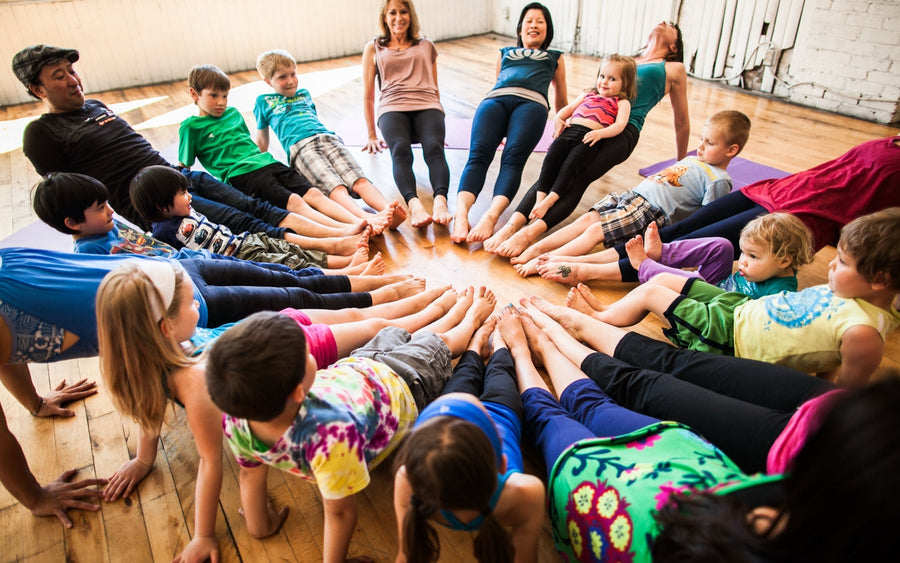
One of Rainbow Yoga’s greatest strengths is that it can move the focus from “How do I look?” to “How do we connect?”
In partner and group yoga, the most interesting question is rarely who has the longest hamstrings. It is whether we can listen, communicate, adjust, support one another and build something together.
The child who cannot perform the flashiest individual pose may be a superb communicator. The cautious child may become the group’s best safety guide. The child with the smallest movement may bring the biggest idea. The one who usually feels watched may suddenly feel needed.
This is body positivity with its sleeves rolled up. Not “Every body is beautiful” floating as a cheerful slogan above the class, but every body genuinely contributing to what the group creates.
Belonging becomes something children experience—not something printed on a poster next to the shoe rack.
Representation is part of the curriculum
We should audit our websites, manuals, cards, presentations and social-media feeds with uncomfortable honesty.
Whose bodies appear?
Do children see different sizes, skin colours, genders, abilities and ways of moving?
Are the same lean, highly flexible bodies always demonstrating the “best” version?
Are photographs selected because they communicate joy, trust and cooperation—or because someone’s leg is doing something alarming near their ear?
Representation teaches before the teacher speaks. If every featured body fits one narrow ideal, children learn who yoga is supposedly for. Adding one diverse photograph on page 73 does not solve this. Diversity is not parsley. We cannot sprinkle it on at the end and declare the meal complete.

Reflection turns movement into learning
The review’s findings point towards an important principle: movement becomes more powerful when children are helped to make meaning from it.
After an activity, we might ask:
- When did your body feel most capable?
- Did you notice yourself comparing?
- What helped you make a choice that was right for you?
- How did your partner help you feel safe?
- What could your body do today that you appreciated?
- Did your body communicate a “yes,” a “maybe” or a “no”?
These conversations need not become solemn conferences in which everyone strokes an imaginary beard. They can be brief, playful and woven naturally into class.
Children might thank a body part for something it helped them do. They might invent three completely different versions of the same pose. They might deliberately make a group shape that cannot possibly be completed unless every person contributes differently.
The point is to help them experience the body as a living companion—not a renovation project.
Body-positive does not mean pretending every child loves their body
“Love your body!” sounds uplifting, but it can become one more demand placed on a child who is struggling.
Some days, body love is too far away. Body respect may be possible. Body curiosity may be possible. Body neutrality may be possible.
Perhaps a child can simply recognise: “This is my body. It deserves food, rest, movement, care and protection, even when I do not feel wonderful about it.”
That is not a lesser achievement. It is honest ground on which trust can grow.
We do not need children to look in the mirror and deliver an acceptance speech. We need to stop giving them reasons to treat their bodies as enemies.
The teacher is part of the practice
Children also notice how we speak about our own bodies.
If a teacher jokes about needing to burn off lunch, complains about getting older, praises weight loss, apologises for their belly or calls food “naughty,” the class receives a body-image lesson whether one was planned or not.
None of us needs to become perfectly healed before teaching. That qualification would leave the profession rather understaffed.
But we do need awareness. We can catch ourselves. We can repair.
“I just spoke about my body unkindly. Let me try that again.”
In doing so, we show children that changing our language is not hypocrisy. It is practice.
The pose is only the doorway
Yoga can help children build a kinder, more trusting relationship with their bodies. But not because Downward Dog possesses secret anti-shame technology.
It happens because a thoughtful teacher creates a culture in which children are not ranked by flexibility, reduced to appearance or pressured past their own signals.
It happens when children see many kinds of bodies participating fully.
It happens when choice is respected, cooperation is valued and reflection helps children recognise what they felt—not merely what they looked like.
It happens when we praise discernment as much as daring, rest as much as effort, communication as much as execution and kindness more than any pose.
Yoga is not automatically body-positive.
That may sound like a criticism. I think it is an invitation.
It means the power does not live mysteriously in the mat, the pose or the playlist. It lives in the culture we create around them.
The pose is only the doorway.
The teaching determines what walks through it.
Research source
Schneider, J., Smith, H. G., Paraskeva, N., & Craddock, N. (2026). A mixed-methods systematic review of the impact of yoga on body image outcomes among children and adolescents. Body Image, 57, 102093.
Keep exploring
More from Kids Yoga Articles
Kids Yoga Articles
The Best Practices Are The Ones Kids Keep Doing
Why choice, connection and meaningful play belong at the heart of kids yoga—with research, practical teaching ideas and a five-minute dragon a...
Read articleKids Yoga Articles
The Bedroom Generation: Children Need More Life, Not Just Less Screen Time
My teenagers spend much of their time in their bedrooms, too. What helps is finding their interests: strength, confidence, adventure and conne...
Read articleKids Yoga Articles
Why Your Favourite Stars Practise Yoga and Mindfulness
Footballers, pop stars, superheroes and a gaming legend also need a moment. Meet seven familiar faces who have spoken about yoga or meditation...
Read article
Comments